Free Food Journal Template (PDF Download)
Download 3 free printable food journal templates. Daily tracker, weekly summary, and meal prep planner to build your journaling habit.

Chris Raroque

A food journal template is a structured printable form for recording what you eat, when you eat, portion sizes, and how you feel before and after meals. Research published in the American Journal of Preventive Medicine found that people who kept daily food journals lost an average of 13 pounds over six months — nearly twice as much as those who did not track their food. A 2019 study in the journal Obesity confirmed these findings, showing that participants who logged food consistently (at least 3 times per day) lost significantly more weight than inconsistent trackers, regardless of the specific method used.
Below you will find three free printable templates: a daily tracker for detailed meal-by-meal logging, a weekly summary for identifying patterns across the week, and a meal prep planner for planning meals in advance. All templates are free to download and print. For a deeper understanding of why food tracking produces measurable results, read the science of food journaling.
What Is a Food Journal?
A food journal is a systematic record of everything you eat and drink, typically including the food name, portion size, time of day, and calorie or nutritional estimates. Food journals can be paper-based (using templates like those below), app-based (using a calorie tracking app), or a combination of both.
The purpose of food journaling is awareness. Most people underestimate their daily calorie intake by 40-50%, according to research published in the New England Journal of Medicine. A food journal closes this perception gap by creating an objective record. Once you can see what you actually eat — not what you think you eat — you can make informed adjustments.
Food journaling is recommended by the Academy of Nutrition and Dietetics, the American Diabetes Association, and most registered dietitians as a foundational tool for weight management, dietary compliance, and identifying food sensitivities.
Download Your Free Food Journal Templates
Daily Food Journal Template
This template provides a structured format for logging everything you eat in a single day, with space for nutritional estimates and self-awareness cues.
What is included:
- Space for breakfast, lunch, dinner, and snacks
- Columns for food description, portion size, and estimated calories
- Water intake tracking (8 glasses to check off)
- Hunger level before eating (1-10 scale)
- Fullness level after eating (1-10 scale)
- Notes section for mood, triggers, or observations
- Daily totals summary row
This template is ideal for:
- Building the initial food journaling habit
- Identifying portion size patterns
- Tracking hunger and fullness cues to recognize emotional eating
- Creating a complete daily record to review with a dietitian
Download Daily Food Journal Template (PDF)
How to use: Print one copy per day or print 30 copies and bind them for a full month. Fill out the template during or immediately after each meal — logging within 5 minutes of eating is the most accurate approach. Write down everything you eat and drink, including small bites and beverages. Be specific: “3 oz grilled chicken breast” is more useful than “chicken.”
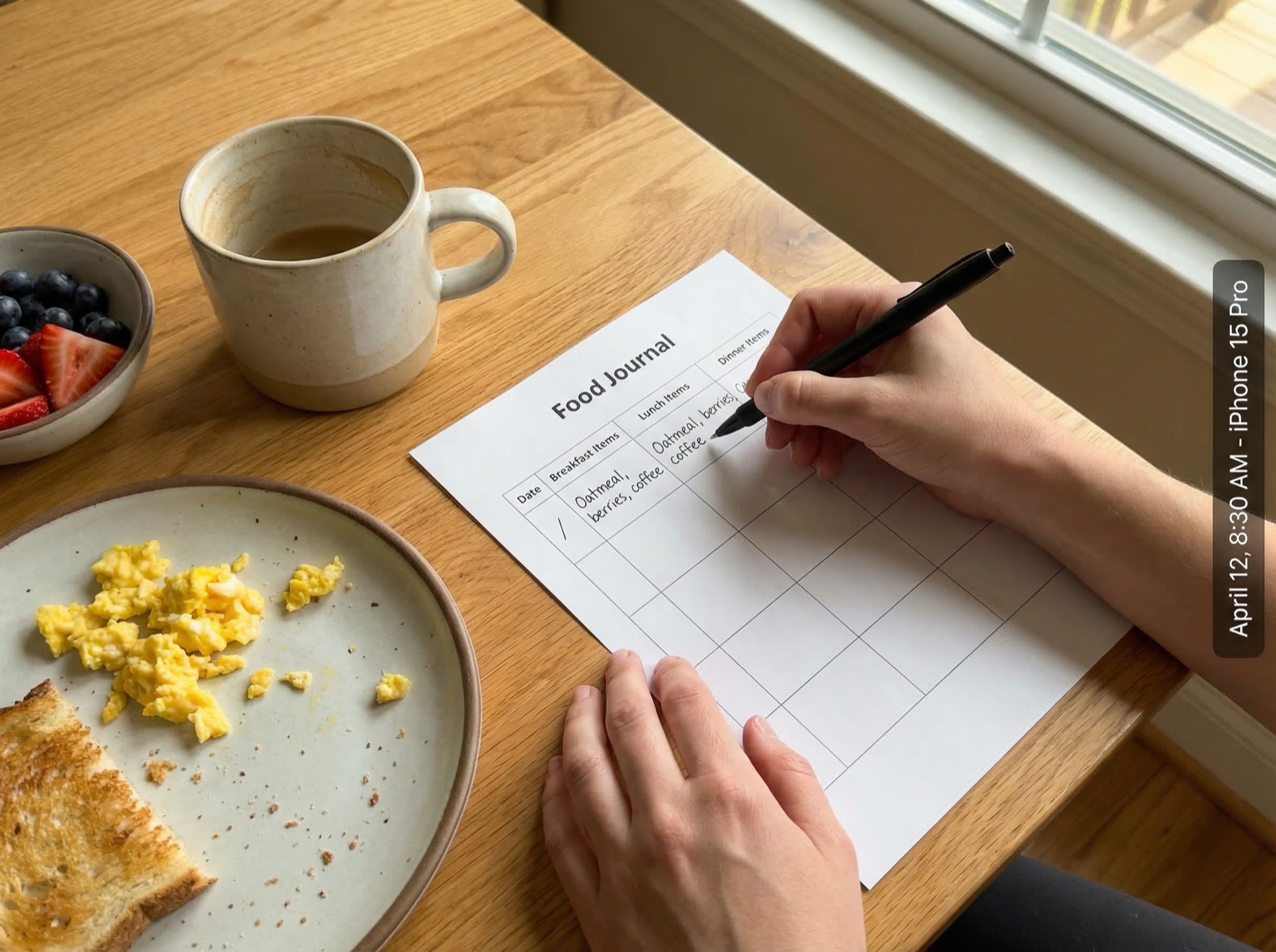
Weekly Food Journal Summary Template
This template condenses an entire week onto a single page, making it easy to spot patterns you would miss looking at individual days.
What is included:
- One-line summaries for each day (breakfast, lunch, dinner, snacks)
- Estimated daily calorie totals for each day
- Seven rows — one for each day of the week
- Weekly average calorie calculation
- Observations section for trends noticed during the week
- Goals and adjustments for the coming week
- Challenges faced and strategies that worked
This template is ideal for:
- Identifying weekly eating patterns (weekend vs. weekday differences)
- Spotting high-calorie or low-calorie days
- Tracking progress toward goals over time
- Weekly check-ins with yourself or an accountability partner
Download Weekly Food Journal Summary (PDF)
How to use: At the end of each week, summarize your daily logs on this template. Spend 5-10 minutes reviewing patterns. Did weekends show higher calorie intake? Did you snack more on certain days? What meals kept you satisfied longest? Use the “Goals” section to identify one specific adjustment for the coming week.
Meal Prep Planning Template
Planning meals in advance makes consistent food journaling dramatically easier because you know what you will eat before the week starts, eliminating guesswork and reducing decision fatigue.
What is included:
- One-week meal planning grid (breakfast, lunch, dinner, snacks for 7 days)
- Shopping list section organized by food category (produce, protein, dairy, grains, pantry)
- Portion sizes and serving counts for each planned meal
- Prep day notes (which meals to prepare in advance)
- Estimated nutrition for planned meals
- Space for recipe links or notes
This template is ideal for:
- Planning meals to hit specific calorie targets
- Creating an organized shopping list
- Reducing decision fatigue and impulse eating during the week
- Batch-cooking and weekend meal preparation
Download Meal Prep Planning Template (PDF)
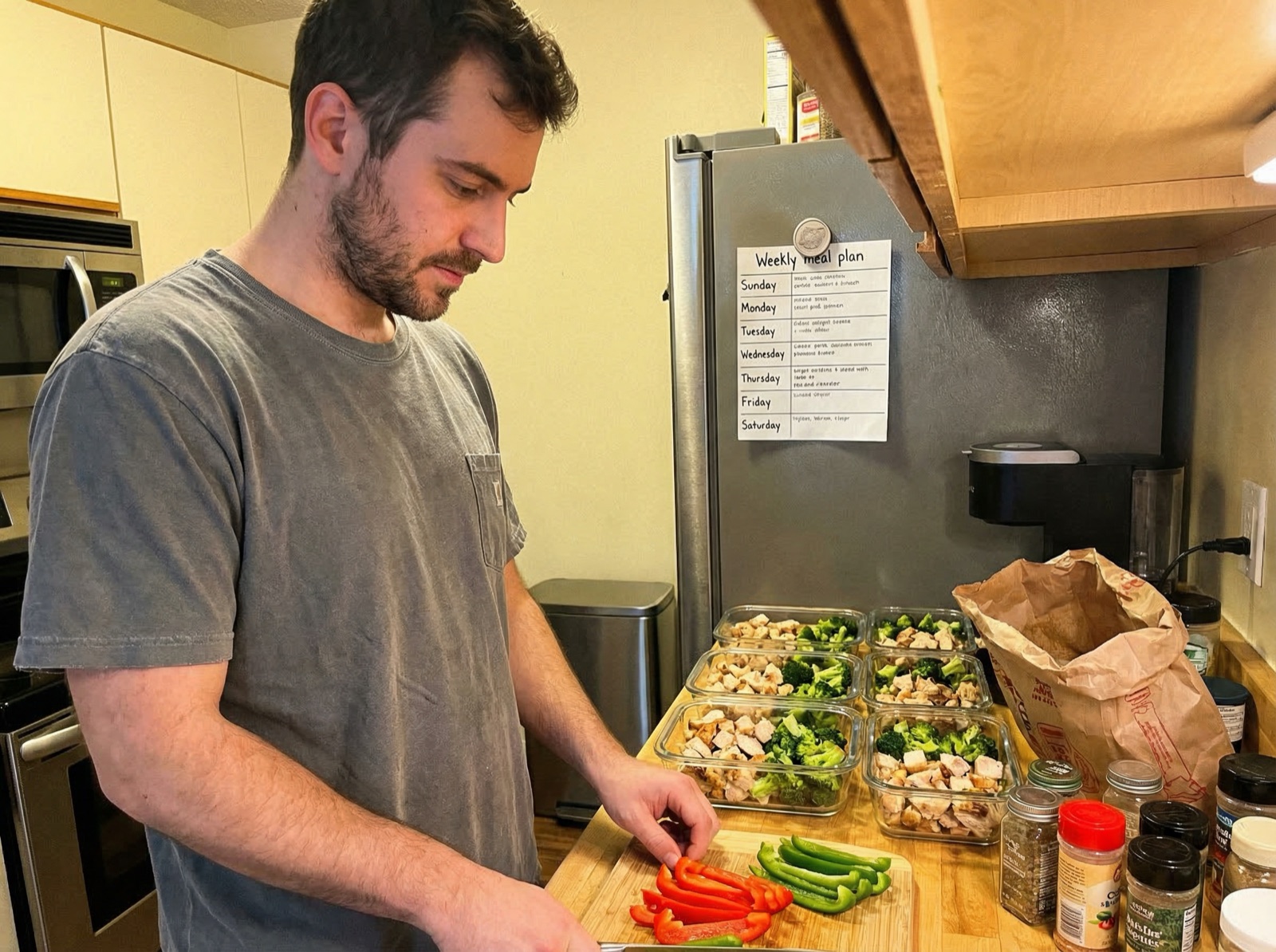
How to use: On your chosen prep day (typically Sunday), plan all meals and snacks for the week. Use our recipe calorie counter to estimate nutrition for homemade recipes. Write portion sizes as specifically as possible — “1.5 cups brown rice” rather than “rice.” Prepare what you can in advance. Having meals planned and prepped makes daily logging faster and more accurate.
How to Use Your Food Journal Template Effectively
Step 1: Print and Position Your Template
Download the template that matches your needs and print copies. Print at least one week of daily templates (7 copies) to start. Place the template somewhere visible — on the kitchen counter, next to your coffee maker, or clipped to the refrigerator. Visibility increases follow-through.
Step 2: Log During or Immediately After Meals
Record food as you eat it or within 5 minutes of finishing. The most common reason food journals fail is delayed logging — waiting until the end of the day results in forgotten items and inaccurate portions. Write down everything, including small bites, condiments, and beverages.
Step 3: Be Specific About Portions
“Chicken and rice” is too vague to be useful. “4 oz grilled chicken breast with 1 cup cooked brown rice and 1 tbsp soy sauce” gives you actionable data. If you are unsure about portions, use common reference points: a deck of cards is roughly 3 oz of meat, a tennis ball is roughly 1 cup, a thumb is roughly 1 tablespoon.
Step 4: Track Hunger and Fullness
The hunger and fullness scales on the daily template are not optional extras — they are key tools for understanding your eating patterns. Over 2-3 weeks of tracking, you will notice patterns: eating when you are not hungry (emotional eating), eating past fullness (portion awareness), or long gaps between meals that lead to overeating.
Step 5: Review Weekly
At the end of each week, transfer daily logs to the weekly summary template and spend 5-10 minutes analyzing patterns. This weekly review is where the real value of food journaling emerges. Look for: weekday vs. weekend calorie differences, consistently high-calorie meals, snacking patterns, and meals that keep you satisfied.
Step 6: Adjust One Thing Per Week
Based on your weekly review, identify one specific, small change for the coming week. Not five changes — one. “I will add a protein source to breakfast to reduce mid-morning snacking” is actionable. “I will eat better” is not. Small, consistent adjustments compound into significant results over months.
What to Track Each Day
The most important data points to record are:
Food and portion size. Be as specific as possible. This is the foundation of every food journal. If you eat out, estimate portions or check the restaurant’s nutrition information. For chains, use our calorie guides for Chipotle, Starbucks, Chick-fil-A, and Dunkin’.
Time of day. When you eat reveals patterns. Common patterns include 3 PM energy-dip snacking, late-night eating after 9 PM, and skipping breakfast followed by an oversized lunch.
Estimated calories. You do not need to be precise — being within 10-15% is effective. Use our calorie deficit calculator to determine your daily target, then estimate whether each meal keeps you on track.
Hunger level (1-10 before eating). Tracking hunger before meals reveals whether you eat out of physical hunger or habit, boredom, and emotion. A score of 1-3 before eating suggests emotional or habitual eating.
Fullness level (1-10 after eating). Tracking fullness helps you recognize when you eat past satisfaction. Consistently scoring 8-10 after meals suggests portion sizes are too large.
Mood or trigger. Were you stressed, bored, tired, or celebrating? This data reveals emotional eating patterns over time. Many people are surprised to discover that stress and boredom drive more eating than actual hunger.
Water intake. Track glasses or ounces of water. Dehydration is frequently mistaken for hunger, and many people find that increasing water intake reduces unnecessary snacking.
You do not need to track every category perfectly. Start with food, portion, and time. Add hunger, fullness, and mood once the basic tracking habit feels automatic (usually after 1-2 weeks).
Tips for Consistent Food Journaling
Make it visible. Keep your food journal on the kitchen counter, not in a drawer. Visibility is the strongest cue for habit formation.
Log immediately, not later. The single most impactful rule for food journal accuracy. Set a personal rule: nothing goes in your mouth without going on the page within 5 minutes.
Be honest, not perfect. If you ate a large portion, write it down. If you had dessert, write it down. The purpose of a food journal is awareness, not judgment. The most valuable entries are the honest ones on difficult days, not the perfect entries on easy days.
Do not skip weekends. Research from Cornell University found that average Americans consume approximately 200-300 more calories on weekends than weekdays. Weekends are the most important days to track because they often explain why weekly calorie averages are higher than expected.
Start with one week. Do not commit to “tracking forever.” Commit to one full week of tracking, then decide whether to continue. Most people who complete one full week choose to continue because the awareness alone changes their behavior. Read our complete how to start a food journal guide for more tips.
Track beverages too. Liquid calories are the most commonly under-reported category in food journals. Coffee drinks, smoothies, juice, alcohol, and soda can add 300-800 calories per day that do not appear in most people’s mental calorie estimates.
Use the meal prep template on Sundays. Planning meals for the coming week takes 15-20 minutes and saves hours of decision-making and logging effort during the week.
Review weekly — this is non-negotiable. The daily log captures data. The weekly review generates insight. Without weekly review, food journaling is just record-keeping. With it, food journaling becomes a behavior-change tool.
Paper Templates vs. Digital Tracking
Paper food journals and digital calorie tracking apps each have strengths. The right choice depends on your personality and goals.
Paper templates are better for:
- Building initial awareness (writing by hand increases cognitive engagement)
- Tracking emotional and behavioral cues (mood, hunger, triggers)
- Users who prefer not to use apps or look at screens during meals
- Short-term tracking projects (4-8 weeks of focused journaling)
Digital apps are better for:
- Long-term daily tracking (months or years)
- Accurate calorie and macro calculations (apps do the math automatically)
- Speed and convenience (photo logging takes 30 seconds vs. 3-5 minutes for paper)
- Users who want automatic summaries, trends, and reports
Many people find the ideal approach is starting with paper templates to build awareness and understand their patterns, then transitioning to a digital app for long-term maintenance. If you are ready to go digital, Amy Food Journal offers the fastest logging experience — take a photo, confirm the calories, done. For a comparison of digital options, see our MyFitnessPal alternatives guide or the full best food journal apps roundup.
Want Something Even Faster? Try Amy Food Journal
While printable templates are valuable for building awareness and understanding eating patterns, digital tracking eliminates the time commitment of manual entry and automates calorie calculations.
If you have tried paper journaling and found it time-consuming, or if you want a faster daily habit while retaining the structured tracking benefits, Amy Food Journal combines the rigor of systematic food logging with the speed of modern AI.
Amy Food Journal lets you:
- Log by photo. Take a picture of your meal. AI identifies the food and estimates calories in seconds. No manual database searching.
- Scan barcodes. Point your phone camera at any packaged food, and nutrition information loads automatically.
- Search the database. For meals without barcodes, search 500,000+ foods and log in seconds.
- Track trends automatically. The app calculates calories, protein, carbs, fat, and daily totals. Weekly patterns emerge without manual math.
- Stay consistent. Logging takes 30 seconds versus 3-5 minutes with paper. This speed difference is the primary reason digital trackers produce better long-term adherence.
The best tracking method is the one you will actually use every day. Paper templates, digital apps, or a combination — consistency matters more than format. If you are learning how to track macros, the app handles the protein, carb, and fat calculations for you. For users focused on weight loss, our calorie counting for beginners guide and calorie deficit calculator will help you set realistic targets.
Try Amy Food Journal free for 3 days
Frequently Asked Questions
What is the best food journal template for beginners?
The daily food journal template is the best starting point for beginners. It provides structured fields for food, portion size, calories, hunger level, and notes without overwhelming you with data points. Start by filling out just the food and portion columns for the first week, then add hunger and mood tracking once the basic habit is established.
Can I use these templates on my computer instead of printing?
Yes. You can open the PDF files in any document editor and type directly into the fields. Digital use works well if you prefer typing to handwriting. For a fully digital experience with automatic calorie calculations, Amy Food Journal offers photo-based tracking that takes seconds per meal.
How many days per week should I track for best results?
Research shows that tracking 6-7 days per week produces the strongest weight loss results. However, the Obesity study (2019) found that even tracking 3 or more times per day on most days was associated with significant weight loss. Tracking 3-4 days per week is substantially better than not tracking at all. The most important single day to track is Saturday, which tends to be the highest-calorie day of the week for most people.
Should I estimate calories or just track foods without numbers?
Both approaches work. Tracking foods without calorie estimates builds awareness of eating patterns and portion sizes. Adding calorie estimates provides more actionable data for weight management. If weight loss is your goal, calorie estimates are more useful — even rough estimates (within 15-20%) produce meaningful results. Use our recipe calorie counter for homemade meals.
Can I modify these templates to track different information?
Absolutely. The templates are starting points, not rigid forms. Common modifications include adding columns for macro tracking (protein, carbs, fat), energy levels, digestion notes, or medication timing. Customize them to match your specific goals.
Is the meal prep template useful if I do not meal prep?
Yes. You can use it as a weekly meal planning tool even without batch cooking. Planning meals in advance — even if you cook them fresh each day — reduces decision fatigue and makes food journaling easier because you know what you are eating before each meal.
How long should I use these templates?
Use daily templates for at least 4-6 weeks to build the tracking habit and identify meaningful eating patterns. A 2012 study in the American Journal of Preventive Medicine found that consistent tracking for 6 months produced the strongest weight loss outcomes. Many people use paper templates for 4-8 weeks to build awareness, then transition to a digital app for long-term tracking.
What if I miss a day of tracking?
Resume tracking the next day. Missing one day does not erase the data you have already collected. Research shows that overall tracking consistency (5+ days per week) matters far more than perfect daily adherence. Never let a missed day become a missed week.
What should I do after I finish using the templates?
After building awareness with paper templates, most people transition to a digital tracker for long-term daily use. See our best food journal apps guide or try Amy Food Journal for the fastest digital option ($9.99/mo after a free 3-day trial). Use our daily calorie calculator to set a calorie target based on the eating patterns you discovered. If you are comparing digital options, our MyFitnessPal alternatives guide covers seven apps in detail.
Can food journaling help with food allergies or sensitivities?
Yes. A food journal is one of the primary tools dietitians use to identify food sensitivities. By tracking what you eat alongside symptoms (bloating, headaches, fatigue, skin reactions), you can identify patterns that point to specific trigger foods. The daily template’s notes section is designed for exactly this kind of observation.
Start Tracking Today
Whether you choose paper templates, a digital app, or both, the most important step is starting. Download a template, print it, and begin logging tomorrow morning.
People who keep food journals lose nearly twice as much weight as those who do not. The template itself is a tool — your consistency is what produces results. Commit to four weeks of daily tracking and you will have a clear, data-driven picture of your eating patterns that would take months to develop through guesswork.
Download your preferred template now and build the food journaling habit. For step-by-step guidance, read our complete how to start a food journal guide. For the science behind why tracking works, see the science of food journaling. And if you are ready to go digital from day one, try Amy Food Journal with a free 3-day trial ($9.99/mo after).
Start tracking with Amy
Track calories like writing in Apple Notes. Just type what you ate.